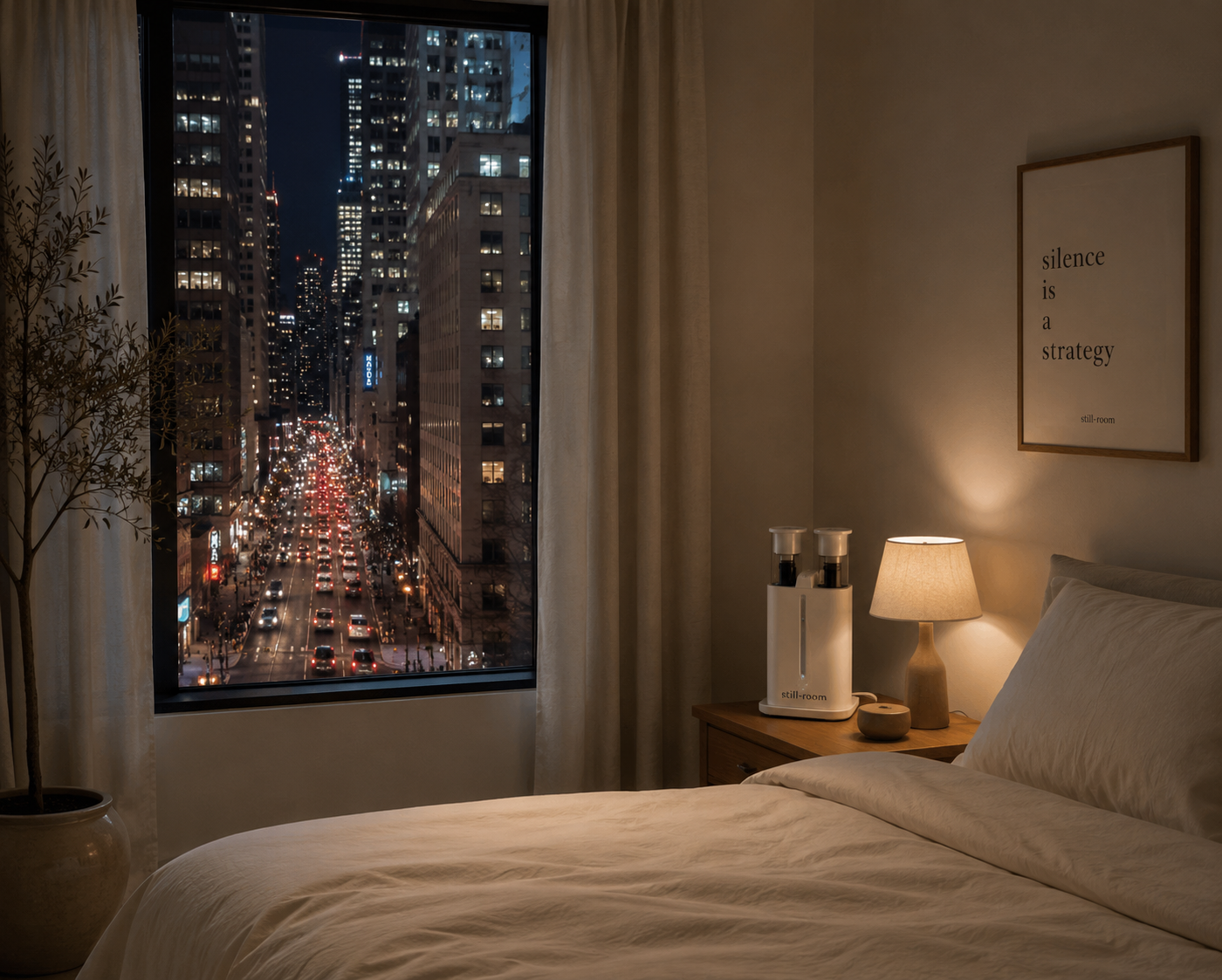
Urban noise: the invisible sleep destroyer
You do not need to wake up to be damaged by noise. A 2023 study published in the European Heart Journal found that nighttime traffic noise above 45 decibels — roughly the level of a quiet conversation in the next room — increased cardiovascular events by 8% per 10dB increment. The mechanism is straightforward: your auditory cortex never fully shuts down during sleep. Every siren, every door slam, every elevator chime triggers a micro-arousal — a brief spike in heart rate and cortisol that fragments your sleep architecture without ever bringing you to consciousness.
This is the insidious nature of urban noise. You sleep through it, so you believe it does not affect you. But polysomnography tells a different story. Subjects exposed to intermittent noise above 40dB spend up to 26% less time in deep slow-wave sleep — the stage responsible for physical repair, immune function and memory consolidation. You wake up tired and blame the mattress, the stress, the late dinner. It was the noise.
Why subconscious noise disrupts sleep architecture
Sleep proceeds in 90-minute cycles, each containing progressively deeper stages. The transition from light sleep (N1, N2) to deep sleep (N3) and eventually REM is fragile — especially in the first two cycles of the night, which contain the highest proportion of slow-wave sleep. A noise event during these transitions does not need to wake you. It simply resets the cycle, bouncing you back to N1. You spend the night cycling through light sleep, never reaching the restorative depths your body requires.
Hotel guests in urban locations report this phenomenon constantly, even in five-star properties. The room is beautiful, the bed is exceptional, but the sleep is shallow. The culprit is almost always acoustic: street noise, HVAC hum, corridor activity, the guest next door. Soundproofing helps, but no hotel window eliminates 100% of external noise. The final barrier must be at the ear.
The mask and buds duo: a controlled sensory environment
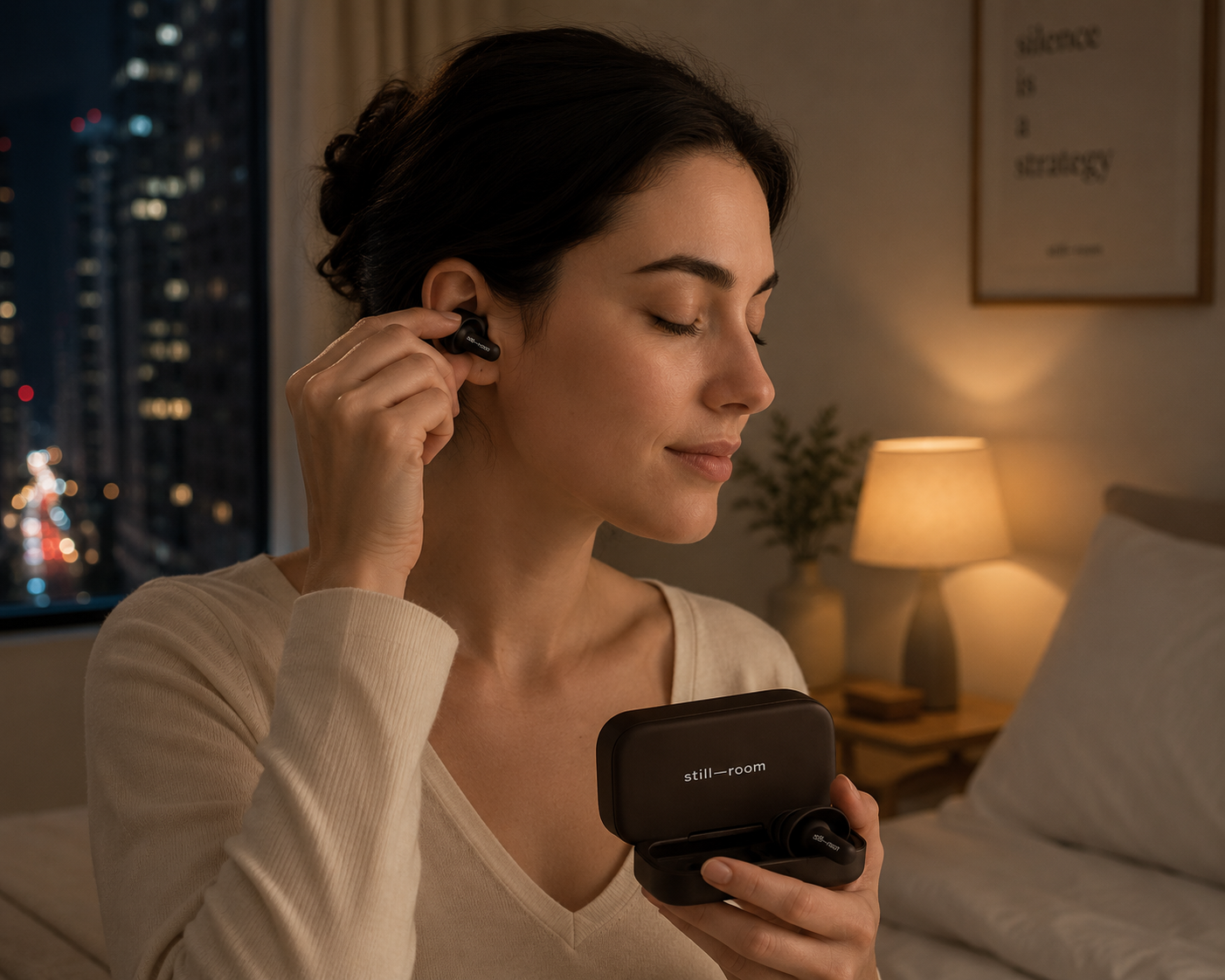
The still—room approach is not to fight the environment but to seal the sleeper from it. The Quiet Peace Ear Buds are engineered from slow-recovery memory foam that conforms to the unique geometry of each ear canal. They achieve a Noise Reduction Rating of 32 decibels — enough to reduce a busy urban street (70dB) to the equivalent of a whisper in a library (38dB). Unlike silicone plugs, they do not create pressure points. Unlike electronic noise-cancelling buds, they require no battery, no Bluetooth, and produce zero electromagnetic emissions during sleep.
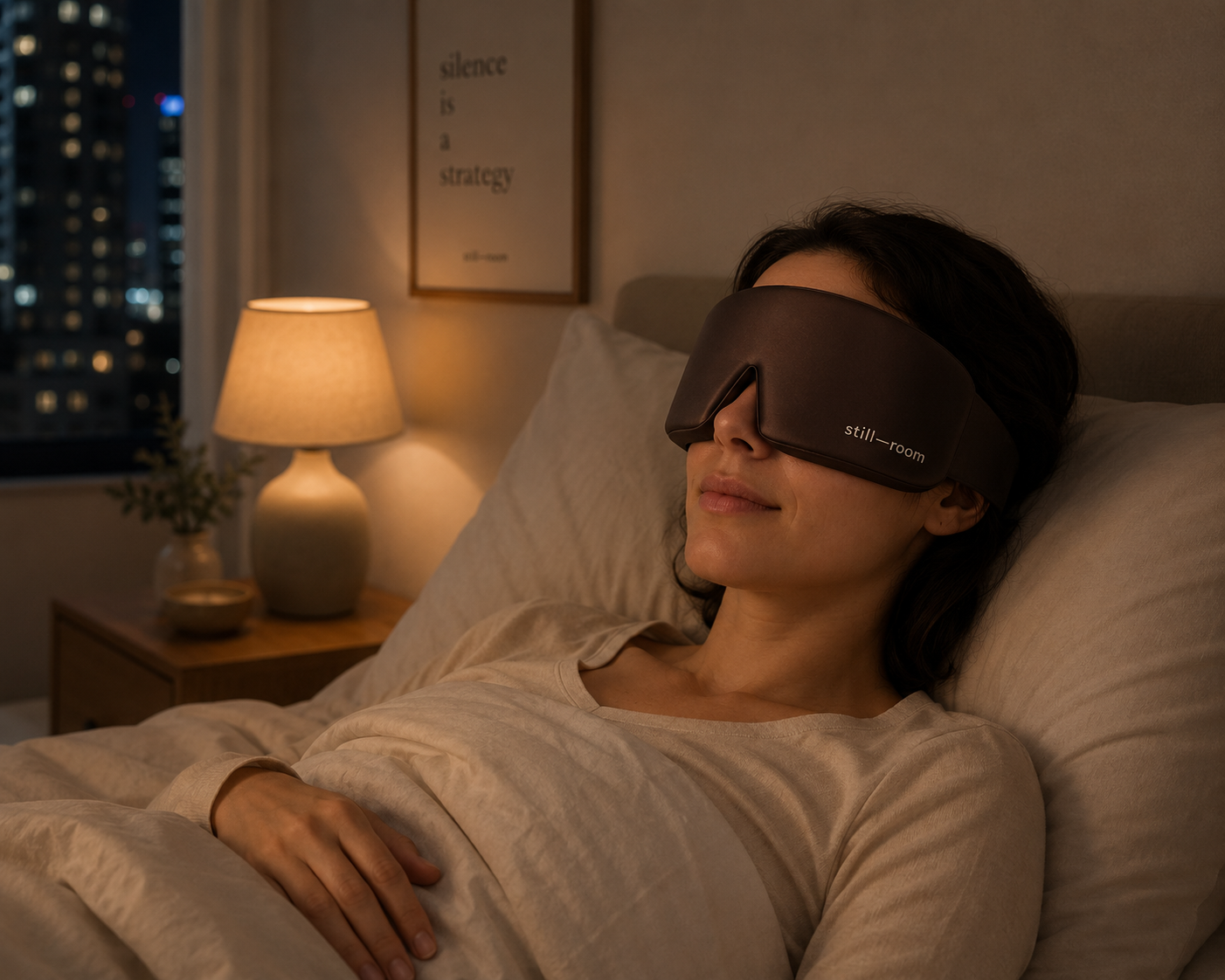
Paired with the Pitch Black Sleep Mask, the combination creates what sleep researchers call a controlled sensory environment — a portable cocoon of darkness and silence that travels with you. Light and noise are the two most potent disruptors of sleep architecture. Eliminate both, and you remove the two variables most likely to fragment your night.
Hotel-tested: 10 properties, one conclusion
Before launch, the mask-and-buds duo was tested across 10 hotel properties in six cities — from a 19th-floor room on a Shanghai arterial road to a courtyard suite in central Paris. Guest sleep surveys showed an average improvement of 1.4 points on a 10-point subjective sleep quality scale. More importantly, guests who used both products together reported feeling rested on the first night in a new room — eliminating the so-called "first-night effect" that typically costs travellers one full night of restorative sleep.
City-proofing your sleep
The principle extends beyond hotels. If you live in any city with ambient nighttime noise above 40dB — which includes virtually every major metropolitan area on earth — your sleep is being compromised, whether you know it or not. City-proofing your sleep does not require moving to the countryside. It requires two things: block the light, block the noise. The still—room duo fits in a jacket pocket. It weighs less than 80 grams combined. And it works on the first night.