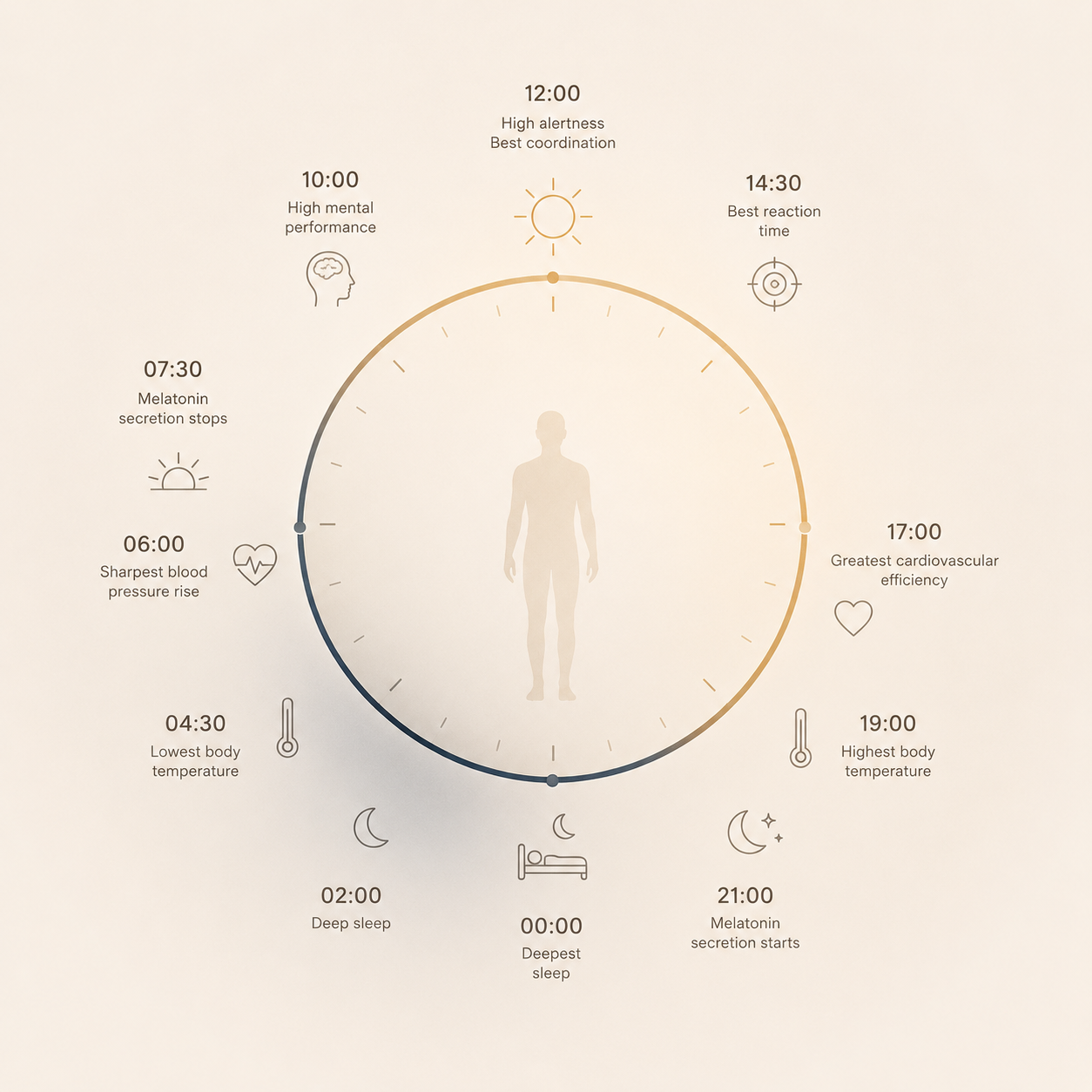
Every cell runs on a 24-hour clock
In 2017, Jeffrey Hall, Michael Rosbash and Michael Young received the Nobel Prize in Physiology or Medicine for their work on the molecular mechanisms that control circadian rhythm. Their discovery was not abstract. It was this: every cell in the human body contains a clock. Not metaphorically. Literally. A set of genes — Period, Cryptochrome, Clock, Bmal1 — that produce proteins in a feedback loop lasting approximately 24 hours. These molecular clocks regulate when your cells divide, when your liver metabolises, when your immune system peaks, when your muscles repair. Disrupt the rhythm, and you disrupt everything downstream.
This is why shift workers have higher rates of cancer, cardiovascular disease and metabolic syndrome. It is why chronic jet lag accelerates cognitive decline. It is why sleeping "enough hours" at the wrong time still leaves you impaired. The clock does not care how long you sleep. It cares when.
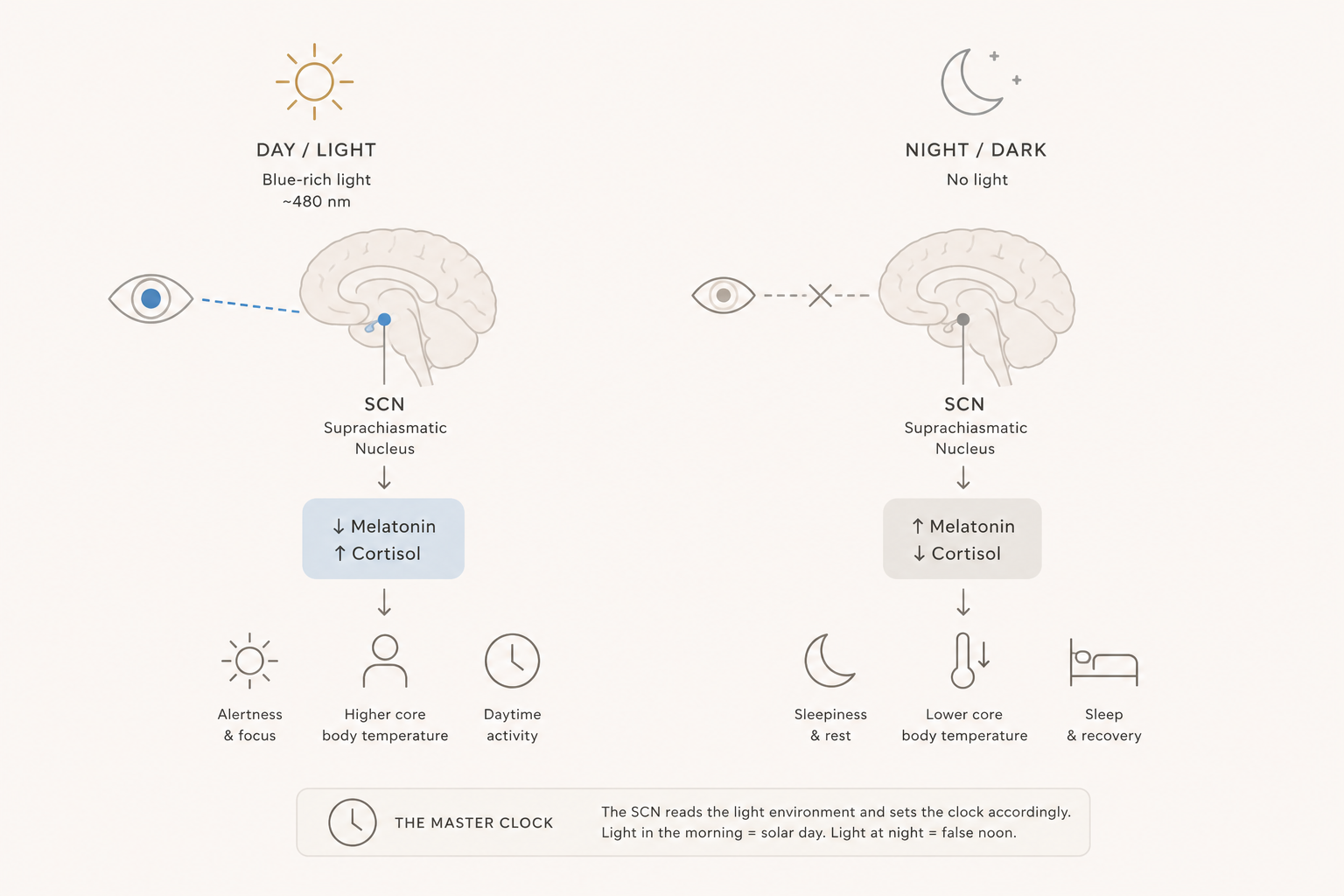
The suprachiasmatic nucleus: your master clock
The conductor of this cellular orchestra sits in a tiny region of the hypothalamus called the suprachiasmatic nucleus (SCN) — a cluster of roughly 20,000 neurons located directly above the optic chiasm, where the optic nerves cross. The SCN receives light information from specialised retinal cells called intrinsically photosensitive retinal ganglion cells (ipRGCs), which are tuned to blue-spectrum light around 480 nanometres. When these cells detect light, they signal the SCN to suppress melatonin and promote cortisol. When light disappears, the SCN initiates the opposite cascade: melatonin rises, cortisol falls, core body temperature drops, and the body prepares for sleep.
This is why light is the single most powerful input to your circadian system. Not food, not exercise, not supplements — light. The SCN reads the light environment and sets the clock accordingly. Give it bright, blue-rich light in the morning, and it locks your rhythm to the solar day. Give it bright light at midnight, and it assumes noon has arrived.
Light as the primary zeitgeber
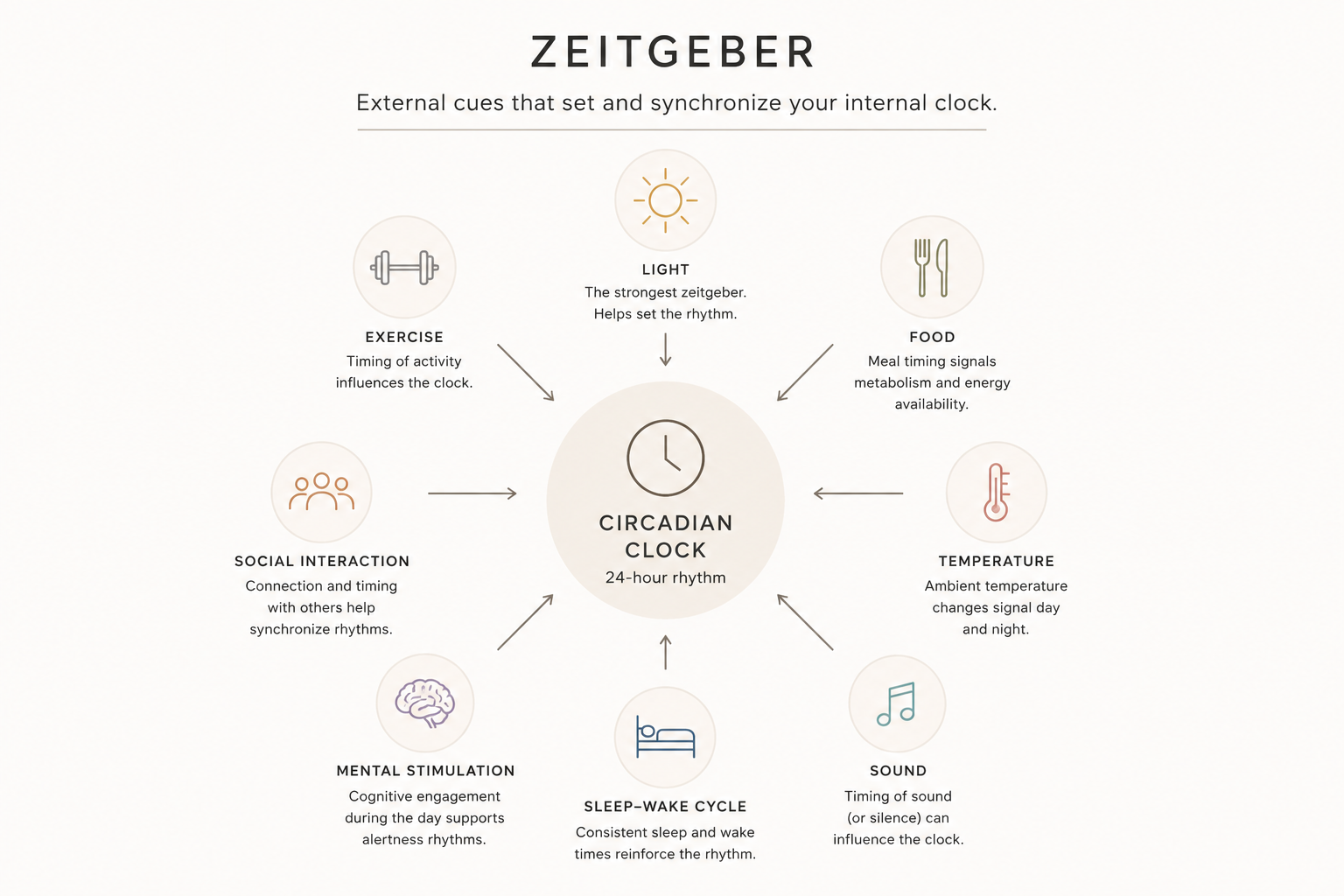
Chronobiologists use the German word zeitgeber — "time giver" — to describe environmental cues that synchronise the circadian clock. Light is the primary zeitgeber, but it is not the only one. Temperature, meal timing, social interaction and physical activity all provide secondary cues. However, light dominates. A single pulse of bright light at the wrong time can shift the circadian clock by up to two hours in a single night. No other environmental signal has that power.
The implication is straightforward: if you want to sleep well, you must control your light environment. Bright, natural light in the first hour after waking anchors the clock. Dim, warm light in the evening permits melatonin onset. Darkness during sleep protects the signal. These are not wellness tips. They are the operating instructions for the most fundamental biological system in your body.
The temperature cycle and the melatonin-cortisol dance
Your core body temperature follows a circadian curve that peaks in the late afternoon (around 37.5°C) and reaches its nadir in the early hours of the morning (around 36.0°C). This temperature decline is not a consequence of sleep — it is a prerequisite. The SCN initiates vasodilation in the extremities (warm hands and feet) to radiate heat from the core, dropping internal temperature by 1-2°C. This thermal signal is tightly coupled with melatonin release: as temperature falls, melatonin rises. As temperature rises in the morning, cortisol takes over.
This is the melatonin-cortisol dance — a reciprocal rhythm that governs alertness and sleepiness across the 24-hour cycle. Cortisol peaks within 30 minutes of waking (the cortisol awakening response) and declines through the day. Melatonin begins to rise 2-3 hours before habitual bedtime (dim-light melatonin onset, or DLMO) and peaks in the middle of the night. When these two rhythms are properly aligned, you feel alert during the day and sleepy at night. When they are misaligned — through irregular schedules, late-night screens or artificial light — you feel neither fully awake nor fully asleep.
How screens destroy your rhythm
The average adult spends 3.5 hours per day looking at screens after sunset. Each of those hours delivers a dose of blue-spectrum light directly to the ipRGCs in your retina — the very cells that set your master clock. A 2014 study from Brigham and Women's Hospital found that reading on a light-emitting device before bed suppressed melatonin by 55%, delayed melatonin onset by 1.5 hours, reduced REM sleep, and increased next-morning grogginess compared to reading a printed book. The effect was cumulative: after five consecutive nights of screen use before bed, subjects' circadian clocks had shifted by nearly 90 minutes.
Blue-light glasses help marginally. Night-mode screen filters help marginally. But the most effective intervention is the simplest one: no screens in the 90 minutes before bed. The circadian system does not respond well to half-measures. A dim screen is still a screen. A filtered screen is still a screen. The only input that permits full melatonin onset is darkness.
The Circadian Nebulizer: scent as a secondary zeitgeber
While light is the primary zeitgeber, the olfactory system offers a powerful secondary entrainment pathway. The still—room Circadian Nebulizer operates on two modes: an AM blend of bergamot, grapefruit and yuzu that aligns with the cortisol awakening response, and a PM blend of lavender, cedarwood and vetiver that aligns with melatonin onset. The principle is olfactory conditioning: by pairing a specific scent with a specific phase of the circadian cycle, the scent itself becomes a zeitgeber — a time-giving cue that reinforces the body's natural rhythm.
This is not a replacement for light management. It is an additional signal layered on top of proper light hygiene, temperature control and consistent sleep timing. The advantage of scent is that it works through the limbic system — beneath conscious awareness, without requiring any behavioural effort. You do not need to remember to dim the lights when the nebulizer has already shifted the room's sensory profile from "morning" to "night." The environment does the work.
No supplements needed — environment is the intervention
The supplement industry has spent billions convincing people that circadian health comes in a capsule. Melatonin pills, magnesium powders, adaptogenic blends — all positioned as solutions to a problem that is fundamentally environmental. Your circadian system does not malfunction because it lacks a supplement. It malfunctions because the environment sends the wrong signals: bright light at night, warm rooms at bedtime, inconsistent wake times, screens in bed.
Fix the environment, and the clock fixes itself. Bright light in the morning. Dim light in the evening. Cool room at night. Consistent scent cues. Consistent timing. These are the inputs your SCN was designed to read. No pill replicates them. No supplement replaces them. The most powerful circadian intervention is not something you swallow — it is the room you sleep in.